

• +44 7864 861589
  • christoph@kopowski.com

Yearly Archive 2026

Elegant meeting room with process diagrams, planning documents and laptop illustrating clarity in IT project management

When an IT Project Loses Momentum: Why Clarity Matters More Than Activity

More meetings, longer status reports and additional tracking tools rarely solve a project’s underlying problems. Sometimes the most valuable intervention is simply to establish what is actually happening.

A familiar situation

The project is running. Meetings take place, tasks are assigned, dashboards are updated and progress reports are distributed. Everyone is busy. And yet, somehow, the project is not moving forward.

Decisions remain unresolved. Requirements are discussed repeatedly. Responsibilities overlap or disappear into organisational gaps. Problems are documented, but not necessarily addressed. From the outside, everything appears reasonably well organised. Inside the project, however, uncertainty is quietly accumulating.

I have encountered variations of this situation throughout my work in IT projects, particularly in complex organisational environments. The interesting question is not always why people are failing to deliver. Quite often, they are working very hard. The question is whether their efforts are directed towards the same, clearly understood objective.

Activity is not the same as progress

Modern project environments offer an impressive collection of tools for organising work. Jira tracks tasks, Confluence stores documentation, dashboards display progress, and meetings provide opportunities for alignment. All of these can be valuable. But none of them automatically creates clarity.

A project may have hundreds of well-maintained tickets and still lack agreement on what the business actually needs. A status report may be entirely accurate while failing to reveal that a critical decision has been postponed for weeks. And a calendar filled with meetings can create the reassuring impression that everything is under control. Unfortunately, a full calendar is not a project deliverable.

The distinction between activity and progress is one of the most important principles in effective project management. It is tempting to measure what is easy to count: completed tasks, closed tickets, workshops held. Those numbers are useful only when they can be connected to an outcome that matters. Otherwise, the organisation becomes exceptionally efficient at describing its own activity.

Where projects begin to lose direction

Requirements are documented but not understood

A requirement is more than a sentence in a specification. It represents a business need, an expected outcome and, often, an assumption about how people or systems should work. When those assumptions remain unexamined, misunderstandings can survive for months.

For example, two departments may agree that a new process should be ‘automated’ while imagining entirely different results. One expects fewer manual steps; the other expects no human intervention at all. Both may approve the same high-level requirement. The disagreement becomes visible only when implementation is well under way.

A structured Business Analysis approach helps distinguish genuine requirements from proposed solutions, clarify dependencies and establish meaningful acceptance criteria. The objective is not to produce more documentation. It is to make the right decisions possible, early enough for them to matter.

Responsibilities are unclear

Projects frequently involve several departments, external service providers, business representatives and technical teams. Everyone has a role. But who actually owns the next decision? Who resolves conflicting priorities? Who is responsible when a dependency crosses organisational boundaries?

When these questions cannot be answered clearly, work slows down. Teams wait for approvals, make assumptions or revisit decisions they believed had already been made. A simple, agreed responsibility structure is often more valuable than another sophisticated reporting mechanism. Clear ownership is not about assigning blame; it is about ensuring that important matters do not fall between the chairs.

Meetings replace decisions

Meetings are essential when they create shared understanding, resolve issues or enable decisions. They become expensive when the same questions return week after week. A useful meeting should have a purpose, the right participants and a clear result. Sometimes that result is a decision. Sometimes it is an assigned action with a responsible owner and a deadline.

If neither happens, it is worth asking whether the meeting is serving the project or merely occupying its calendar. I prefer a short, focused discussion that removes a blocker to an elaborate workshop that produces another list of open questions. Preparation and follow-through are rarely glamorous, but they are where much of the value is created.

Reporting describes the past but does not guide the future

A good project report should do more than communicate what happened last week. It should help management understand what requires attention now. Which decisions are overdue? Which dependencies threaten delivery? Which risks have become issues? Where does the project need support?

A green status indicator can be reassuring, but it is not an answer in itself. If important assumptions remain untested, a project can appear healthy until a critical milestone is missed. The value of reporting lies not in the number of charts but in the quality of the decisions those charts enable.

The first step is not necessarily a new methodology

When a project begins to struggle, there is often pressure to introduce something new: a framework, a tool, a meeting structure, perhaps even a complete reorganisation. Occasionally, such changes are necessary. But before adding complexity, I prefer to establish a clear picture of the existing situation.

That means understanding the intended outcome, reviewing the actual state of delivery, identifying unresolved decisions and making critical dependencies visible. It also means speaking with the people who perform the work. They frequently know where the real difficulties lie, even when official reporting does not fully reflect them.

In practical terms, this might begin with a small number of conversations and a review of the existing requirements, decision log, risks and delivery plan. Where do descriptions contradict one another? Which actions have no owner? What is blocked by an external dependency? The purpose is to create a shared picture that is sufficiently accurate to act upon, not to conduct an elaborate diagnostic exercise that becomes another project in itself.

What effective PMO and Business Analysis contribute

Project Management Office support and Business Analysis are sometimes treated primarily as administrative or documentation functions. That interpretation misses much of their potential value. When applied effectively, they connect business objectives with operational delivery.

Business Analysis helps establish what needs to be achieved and why. It makes expectations explicit, exposes conflicting assumptions and translates business needs into something teams can evaluate and deliver. PMO provides transparency around progress, dependencies, responsibilities, risks and decisions. It helps ensure that the information needed for steering is available, understandable and current.

Together, these disciplines can create the conditions in which project teams work with greater confidence and fewer unnecessary interruptions. This does not require taking control away from the people doing the work. On the contrary, good structure should enable them to concentrate on it. The best process is not necessarily the most elaborate one; it is the one that helps people move forward reliably.

Calm is a professional advantage

Complex projects rarely benefit from unnecessary drama. When deadlines approach and pressure increases, the temptation to respond with more activity is understandable. But urgency should not be confused with effectiveness. A calm, analytical approach makes it easier to distinguish between symptoms and causes, identify priorities and communicate difficult information without creating additional uncertainty.

This matters particularly in regulated environments, including banking, where traceability, accountability and reliable delivery are essential. It is possible to be candid about a problem without making it theatrical. A clearly described risk, a realistic decision request and a credible next step will generally serve a project better than a dramatic escalation without a proposed way forward.

Calmness is not passivity. It is the discipline to respond deliberately rather than react automatically. And it requires the confidence to say, when necessary, that a project needs clarity before it needs more speed.

Five questions worth asking

When a project appears busy but progress remains uncertain, I would begin with five questions:

  1. What specific outcome are we trying to achieve?
  2. Which requirements and priorities are genuinely agreed?
  3. Who is responsible for the decisions currently holding us back?
  4. Which dependencies and risks could prevent delivery?
  5. What needs to happen next — and who will make it happen?

These questions are not complicated. Obtaining clear, consistent answers can be surprisingly difficult. And that is precisely why they matter. If the answers differ depending on whom you ask, the discrepancy itself is useful information: it shows where alignment is missing and where the next conversation should begin.

Clarity before complexity

Successful project delivery does not necessarily depend on introducing more processes, more meetings or more sophisticated tools. It depends on ensuring that people understand the objective, their responsibilities and the decisions required to move forward.

My work in Business Analysis, Project Management and PMO has repeatedly reinforced one principle: Structure should make work easier, not become additional work. When a project loses momentum, the first priority is not always to move faster. Sometimes, it is to establish where we are going — and then make sure everyone is moving in the same direction.

Christoph Kopowski works in Business Analysis, Project Management and PMO, supporting organisations with requirements, processes and structured delivery, particularly in complex IT and banking environments.

The Illusion of Simplicity: Why Minimalist Software Design Is Often a Step Back

An argument for visible functions, logical structures and software that helps people work instead of sending them on a treasure hunt.

Here I am again, sitting in front of a piece of software, looking for a function that I know exists.

I search. And search. And search.

Eventually, I ask an AI assistant for help. It politely tells me to click a particular icon. I look at the screen, only to discover that I cannot even find the icon it is referring to.

Welcome to the wonderful world of modern software design.

I find this increasingly frustrating. Not because today’s applications lack functionality. Quite the opposite: many are extraordinarily capable. The problem is that their capabilities are becoming progressively harder to discover.

The interface looks clean. Everything appears simple. Yet finding what you need can feel unnecessarily complicated.

That is not progress. It is a step backwards in usability.

When Software Had a Visible Structure

Traditional desktop applications often followed a recognisable structure: File, Edit, View, Tools, Window and Help.

These menus were hardly glamorous. Some applications were cluttered, and not every design decision was sensible. But there was one considerable advantage: you could explore the software systematically.

You could open a menu, see what was available and gradually understand how the application worked.

A well-organised menu was effectively a map of the software.

Today, we are increasingly presented with three dots, a hamburger menu, a gear icon and a collection of symbols whose meaning is not always obvious.

Behind these innocent-looking icons may be dozens of functions. Even experienced users can find themselves searching for familiar features after yet another redesign.

Complexity does not disappear simply because its controls are hidden. It merely becomes less visible.

This Is More Than Nostalgia

The criticism of hidden navigation is supported by usability research.

In 2016, Kara Pernice and Raluca Budiu of the Nielsen Norman Group reported that hidden navigation performed worse than visible navigation in several usability measures. Their findings included reduced discoverability and difficulties with task completion.

In the navigation patterns they tested, hiding navigation nearly halved its discoverability. This finding should not be treated as a universal statistic for every application, but it is a compelling warning against hiding important functionality without good reason.

Research: Hamburger Menus and Hidden Navigation Hurt UX Metrics – Nielsen Norman Group

Of course, defenders of minimalist interfaces have a legitimate argument.

Not every advanced option needs to remain visible all the time. Jakob Nielsen’s principle of progressive disclosure recommends showing essential features first and revealing more specialised options when necessary.

Used intelligently, this approach can help beginners and reduce unnecessary distractions.

Research: Progressive Disclosure – Nielsen Norman Group

But there is a crucial distinction between organising complexity and concealing it. An interface that makes its structure understandable is not the same as one that simply hides most of its functions.

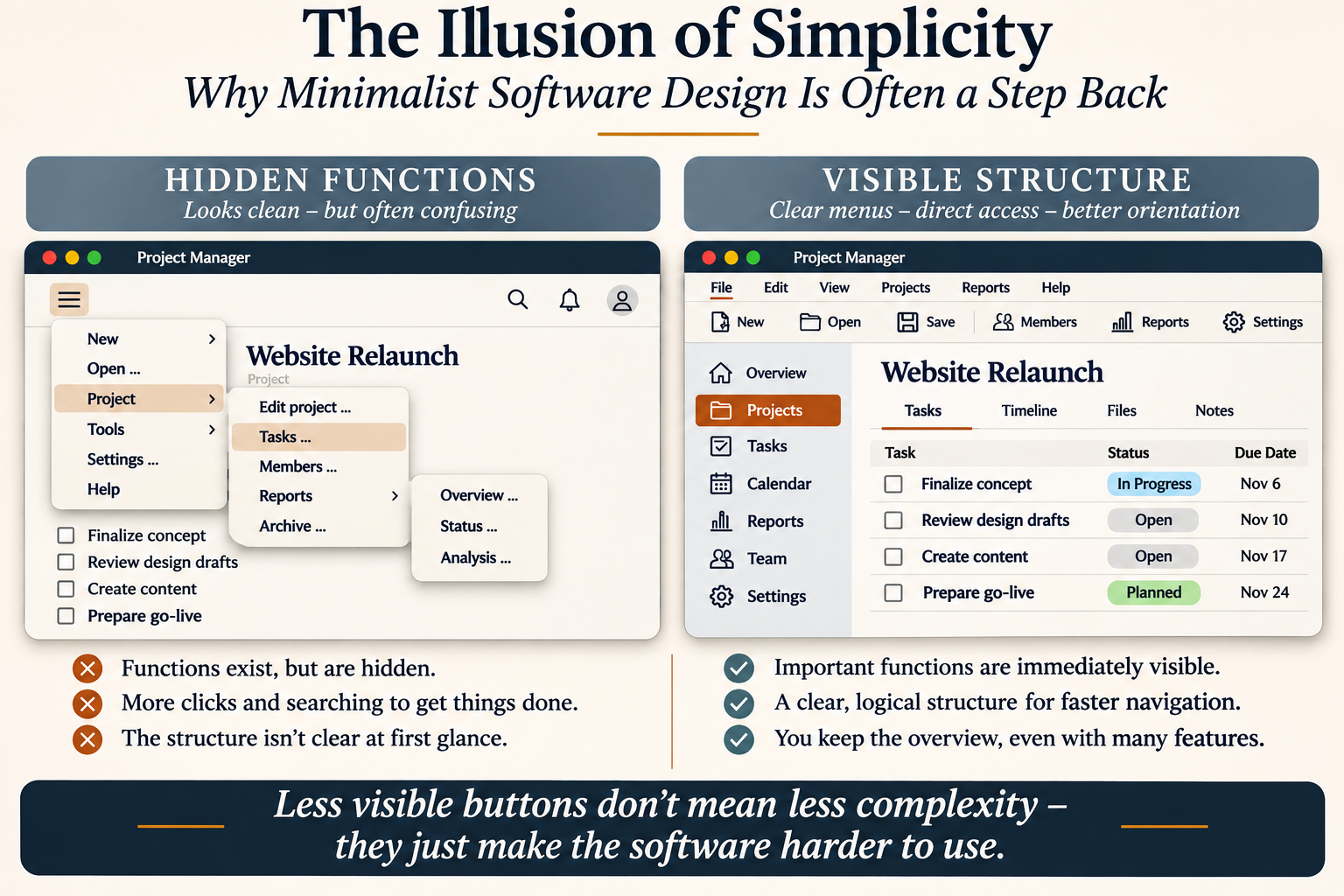
Two Interfaces, One Application

Imagine two versions of the same project management application.

Both offer project planning, task management, reporting, team administration and settings.

The first version displays only a few controls. Important functions are hidden behind several layers of menus.

The second version provides a visible menu bar, clearly labelled tools and a logical navigation structure.

Both are equally capable. But the second immediately communicates what the application can do.

Illustration: Two fictional project management interfaces demonstrating hidden functions and visible navigation. This is a conceptual comparison, not an empirical usability test.

This does not prove that traditional interfaces are always faster. Usability depends on the tasks, the users and the quality of implementation.

However, a visible structure provides something valuable before the user even begins working: orientation.

Mobile First Must Not Mean Desktop Second

Another common justification for minimalist design is the mobile-first philosophy.

Designing for smartphones makes perfect sense when people use an application on a small touchscreen. But why should that automatically determine how the same application behaves on a large desktop monitor?

Professionals working with complex documents, business processes, financial data or project plans often spend their working days at laptops and desktop computers.

They need efficient navigation, clear labels, visible tools and an overview of their work.

There is room on a desktop screen. Why not use it intelligently?

Accessibility matters, too. Tiny icons, low contrast and ambiguous controls can create additional difficulties, particularly as users grow older or their eyesight changes.

Good design should adapt to people and their tasks, rather than forcing every user into the same aesthetic philosophy.

Simplicity Is Not the Same as Emptiness

I have nothing against elegant software. I appreciate a clean, attractive interface as much as anyone.

But appearance must never become more important than usability.

When an application looks simple but requires extensive searching, the simplicity is largely an illusion.

I am not suggesting that we should return to every grey dialogue box of the 1990s. What I want is something more intelligent: clear menus, meaningful labels, consistent navigation and an understandable hierarchy of functions.

Advanced features can certainly be organised into additional menus. But essential functions and the basic structure of an application should remain readily discoverable.

The software industry needs to remember a fundamental principle:

The best interface is not necessarily the one with the fewest visible buttons. It is the one that allows people to complete their work efficiently, confidently and without unnecessary searching.

Give users their overview back.

Because good software should not merely look easy to use.

It should actually be easy to use.


Editorial note: This opinion article is associated with the end of August 2026. The opening example involving Firefox and AI assistance was added in November 2026. The cited research was published in 2006 and 2016.


Beauty Is Not a Luxury. It Is Part of Performance.

I am sitting at my desk.


The windows are wide open. A gentle summer breeze drifts into the room, carrying the scent of warm timber, fresh grass and the garden beyond. Outside, the leaves sway quietly in the morning light. Bright greens blend with darker shades, while a few reddish leaves catch the sun. Somewhere, a blackbird begins to sing.


I take a sip of coffee.


No traffic.

No rushing.

No constant interruptions.


Just calm.


My desk is tidy. Everything is exactly where it needs to be. The screen faces a window instead of a blank wall, and beyond that window lies something no office designer can truly recreate: nature.


And then something remarkable happens.


Ideas seem to arrive more naturally.

Complex problems become easier to untangle.

Creativity does not feel forced.

It simply appears.


I am focused.

Motivated.

Completely absorbed in my work.


Not because I suddenly became more disciplined.


But because my surroundings invite me to do my best work.


Then I picture another workplace.


The alarm rings an hour earlier.


A hurried breakfast.

A crowded train.

Traffic jams.

Delays.

Commuting before the working day has even begun.


By the time the office door opens, energy has already been spent.


Grey carpet.

White walls.

Artificial lighting.

Conditioned air.

Rows of identical desks.

Phones ringing.

Someone attending yet another online meeting without headphones.

Colleagues rushing from one appointment to the next, with barely enough time for a genuine conversation.


Instead of birdsong, there is the hum of printers.

Instead of fresh air, recycled air conditioning.

Instead of trees, partition walls.


And after eight hours, the journey begins again.


Another commute.

Another hour.

Sometimes two.

Time that quietly disappears from life, day after day.


And then we wonder why so many people feel exhausted.


Beauty is not a luxury.


Somehow we have come to believe that beautiful workplaces are a pleasant extra.


Something reserved for glossy architecture magazines.

Something for impressive company headquarters.

Something nice to have.


I believe we have misunderstood something fundamental.


Beauty is not decoration.


Beauty is part of performance.


Environmental psychology has been studying this relationship for decades.


The question is surprisingly simple.


How does our environment influence the way we think, feel and work?


The answer is becoming increasingly clear.


People tend to perform better when they genuinely enjoy the place in which they work.


Our minds were never designed for sterile spaces.


For hundreds of thousands of years, humanity lived among forests, rivers, changing seasons and natural landscapes.


Only within the last tiny fraction of our history have we surrounded ourselves with concrete, glass, fluorescent lighting and endless white walls.


Our biology has not changed nearly as quickly as our architecture.


This is why nature still affects us so profoundly.


Not because it is fashionable.

Because it is deeply human.


Research in environmental psychology consistently suggests that exposure to daylight, natural materials, vegetation and views of nature can reduce stress, improve wellbeing and support sustained attention. The growing field of biophilic design is built upon precisely this understanding.


The home office can become exactly that place.


Not every home office, of course.


A laptop squeezed between yesterday’s dishes and the washing basket is hardly an inspiring workplace.


But a thoughtfully designed room with daylight, fresh air, plants and a peaceful atmosphere can become something quite different.


Not merely a place to work.

A place where good work becomes easier.


That distinction matters.


Motivation rarely grows from supervision.

It grows from trust.

From ownership.

And from environments that support rather than exhaust us.


Trust will always outperform control.


Many organisations still ask whether employees really work when they are at home.


I sometimes wonder whether that is the wrong question entirely.


Perhaps we should instead ask:


Under which conditions do people produce their very best work?


Great ideas rarely emerge because someone was required to sit at a particular desk.


They emerge through concentration.

Through autonomy.

Through deep thinking.

And through environments that allow people to flourish.


Constant interruptions rarely create innovation.

Long commutes rarely increase creativity.

Sterile workplaces rarely inspire original thinking.


Beauty quietly changes us.


Perhaps we underestimate beauty itself.


A well-kept garden calms the mind.

An old library invites reflection.

A walk beneath ancient trees often solves problems that hours at a desk could not.

A room filled with natural light changes our mood before we even notice it.


Why should our workplaces be any different?


We spend a remarkable portion of our lives working.


Surely the places in which we spend those years should nourish us rather than merely contain us.


Productivity begins long before the first task.


It begins with the first breath of fresh morning air.

With daylight falling across the desk.

With silence.

With beauty.

With a place where we genuinely want to be.


Perhaps that is the real lesson.


People seldom produce extraordinary work because they are under constant pressure.


They produce extraordinary work when they are given the opportunity to become the best version of themselves.


A beautiful workplace is therefore not an indulgence.


It is an investment.


In wellbeing.

In creativity.

In motivation.

In healthier organisations.

And ultimately, in better results.


The finest ideas rarely emerge beneath fluorescent lights.


More often, they begin beside an open window, while a gentle breeze moves through the trees and quietly reminds us that, despite all our technology, we remain creatures of nature.


Sources & Further Reading

The ideas explored in this essay are supported by decades of research in environmental psychology, architecture, neuroscience and organisational behaviour. If you would like to explore the scientific background in greater depth, the following publications provide an excellent starting point.


  • Kaplan, Rachel & Kaplan, Stephen (1989)
    The Experience of Nature – A Psychological Perspective.
    One of the foundational works introducing the concept that natural environments help restore directed attention and reduce mental fatigue (Attention Restoration Theory).
    https://archive.org/details/experienceofnatu0000kapl

  • Ulrich, Roger S. (1984)
    View Through a Window May Influence Recovery from Surgery.
    Science, Vol. 224, No. 4647.
    This landmark study demonstrated that patients with a view of trees recovered faster and required less pain medication than patients facing a brick wall.
    https://www.science.org/doi/10.1126/science.6143402

  • Boubekri, Mohamed et al. (2014)
    Impact of Office Window and Daylight Exposure on Sleep, Physical Activity and Quality of Life.
    Journal of Clinical Sleep Medicine.
    The study found that employees working in offices with windows experienced better sleep quality, greater physical activity and improved overall wellbeing compared with those working in windowless environments.
    https://jcsm.aasm.org/doi/10.5664/jcsm.3780

  • Bloom, Nicholas et al. (2015)
    Does Working from Home Work? Evidence from a Chinese Experiment.
    The Quarterly Journal of Economics.
    One of the world’s best-known studies on remote work. The experiment found higher productivity, lower employee turnover and increased job satisfaction among home-based workers under appropriate conditions.
    https://doi.org/10.1093/qje/qju032

  • Human Spaces (2015)
    The Global Impact of Biophilic Design in the Workplace.
    Based on responses from more than 7,500 office workers across sixteen countries, the report found strong associations between natural elements in the workplace and higher wellbeing, creativity and reported productivity.
    https://humanspaces.com/the-global-impact-of-biophilic-design-in-the-workplace/

  • Browning, William D., Ryan, Catherine O. & Clancy, Joseph O. (2014)
    14 Patterns of Biophilic Design.
    One of the most influential practical frameworks for integrating nature into architecture and workplace design.
    https://www.terrapinbrightgreen.com/reports/14-patterns/

  • World Green Building Council
    Health, Wellbeing & Productivity in Offices.
    A comprehensive review of international research examining how workplace design influences health, engagement and organisational performance.
    https://worldgbc.org/article/health-wellbeing-productivity-offices-the-next-chapter-for-green-building/

Author’s Note

This essay combines personal reflection with findings from environmental psychology, workplace research and architecture. While every individual experiences work differently, a growing body of scientific evidence suggests that our surroundings are far more than a backdrop. They shape how we think, how we feel and, ultimately, how well we perform.

Consistency – The Quiet Force Behind Lasting Success

Every day begins almost the same way for me.


A good cup of coffee. A long walk with my dog. Then a workout.


Not because I jump out of bed every morning full of motivation. Quite the opposite. There are days when I would happily sleep another hour or when my mind is already occupied with projects, deadlines, or the current economic situation.


And yet, I start my day exactly like this.


Why?


Because motivation comes and goes. Consistency remains.


Success Rarely Comes from One Big Moment


Many people wait for the perfect moment. The big opportunity. The one assignment that changes everything.


In my experience as a Business Analyst and Project Manager, reality works differently.

The most successful projects are not built on isolated heroic efforts. They are built because a team becomes just a little better every single day.


  • Documenting a requirement properly.
  • Following up on an open risk.
  • Having a meaningful conversation with a stakeholder.
  • Improving a process diagram.
  • Adding another test case.

Individually, these tasks may seem rather ordinary. Over weeks and months, however, they create quality. And very often, that quality determines whether a project succeeds or fails.


Consistency beats perfection.


The Same Applies to Learning New Skills


Anyone working in IT or project management today knows the feeling:


  • New methodologies
  • New tools
  • New technologies
  • New requirements

It is easy to feel as though you are constantly trying to catch up.


But nobody has to become an expert over a single weekend.


Those who invest just 20 or 30 minutes every day will learn more over the course of a year than many people who only occasionally decide that “this time I’m really going to start.”


  • Read one chapter.
  • Watch one video.
  • Try one new feature.
  • Complete one small exercise.

Nothing spectacular. But incredibly effective.


As a Freelancer, Consistency Makes the Difference


The past months have shown many freelancers that the market has become more challenging.


  • Projects are being postponed.
  • Budgets are being reduced.
  • Decisions take longer.

Of course, there are days when you wonder whether submitting the next application is even worth it.


That is exactly when consistency becomes the deciding factor.

Not sending ten applications on one productive day and then doing nothing for the next week.

Instead, doing something every single day.


  • Update your profile.
  • Talk to a recruiter.
  • Submit an application.
  • Expand your professional network.
  • Improve your CV.
  • Start a new certification.

None of these activities may lead directly to your next project.


Together, however, they increase the likelihood every single day that the right opportunity will eventually appear.


Consistency Builds Trust


Clients notice very quickly whether someone is reliable.


  • A status report that always arrives on time.
  • A well-maintained backlog.
  • Clear documentation.
  • Transparent decision-making.
  • Honest communication.

These things may seem obvious.


In practice, however, this level of reliability is one of the greatest competitive advantages you can have.


People enjoy working with professionals they know they can rely on.


Small Steps Are More Powerful Than Grand Intentions


We often overestimate what we can accomplish in a single day.


At the same time, we dramatically underestimate what we can achieve in a year by making small, consistent improvements every day.


  • One workout hardly changes your body. One hundred workouts certainly do.
  • One lesson does not make you an expert. Three hundred lessons might.
  • One application does not guarantee a project. Consistent applications often lead to the opportunity you’ve been waiting for.

My Personal Conclusion


That is why I continue to begin every day with a good cup of coffee, a walk with my dog, and a workout.


Not because every morning is perfect.


But because this routine reminds me that progress is rarely loud.


It is built through small decisions.

Through daily habits.


Through discipline.


And above all, through consistency.


Because in the end, careers, projects, and businesses are rarely built by giant leaps.


They are built by the small steps we are willing to take every single day.

Scrum = Endless Meetings?

When Scrum Becomes a Meeting Machine

Agile project management is meant to accelerate value creation, not suffocate it in the calendar.

Reading time: approximately 7 minutes

In its original form, Scrum is not a cumbersome administrative apparatus, but a lightweight framework for leadership and delivery. That is precisely where its appeal lies: clear roles, clear cadence, clear responsibilities.[1] And yet many companies experience something entirely different: the day begins with the Daily Scrum, continues with refinement, stakeholder calls, alignment sessions, steering meetings and review preparation, and ends exactly where the actual work finally begins – in the evening.

To avoid misunderstandings: agile methods can indeed lead to better results. A large quantitative study of 1,002 projects shows a positive relationship between agile working, efficiency and stakeholder satisfaction.[11] The problem, therefore, is not agility itself. The problem is poor execution.

Anyone familiar with this situation feels the problem not only organisationally, but physically. After a day full of meetings, one is mentally tired, even though one has formally “done a lot”. One was busy, but not necessarily effective. Developers typically describe productive days not as days full of interruptions, but as days on which they can move substantial tasks forward with as few context switches as possible.[4]

“Simplicity — the art of maximising the amount of work not done — is essential.”

Principles behind the Agile Manifesto[2]

When Agility Is Misunderstood

Poor Scrum is not recognised by the fact that people talk to one another. It is recognised by the fact that communication becomes a substitute for leadership, prioritisation and clean product work. Every open issue is turned into a meeting. The backlog is vague, so it is discussed live. Responsibilities are not clearly separated, so too many people sit at the table. The Product Owner effectively becomes a committee, so prioritisation is renegotiated constantly. The Daily Scrum becomes a status show for management, although in truth it is intended for the daily adaptation of work towards the Sprint Goal.[1]

A second misconception is added to this: many companies confuse agile visibility with permanent availability. Yet visibility does not arise because everyone is everywhere. Visibility arises through clear goals, good artefacts, reliable decisions and documented results. If meetings instead become the primary steering instrument, work shifts out of the product and into the calendar.

Research describes precisely this mechanism. Microsoft reports that half of all meetings take place in exactly those time windows in which many people have natural productivity peaks; at the same time, the analysis shows how strongly focus work is fragmented by a mixture of meetings, messages and notifications.[3] Developer research adds that interruptions and context switching are not marginal issues, but central factors influencing the experience of productivity.[4]

The cost of such fragmentation becomes even clearer in interruption research: people sometimes work faster under interruption, but they pay for it with more stress, higher frustration, greater time pressure and increased effort.[5] More recent research in software engineering also shows that the type and urgency of interruptions can measurably alter processing time and stress responses.[6]

Does It Always Have to Be This Way?

No. And professionally speaking, it must not be this way if Scrum is taken seriously. The Scrum Guide explicitly describes Scrum as a lightweight framework with clearly time-boxed events. These events are intended to create regularity and specifically to minimise the need for additional meetings.[1] A Daily Scrum is limited to 15 minutes. Sprint Planning, Review and Retrospective also have clear maximum durations. Scrum is therefore not designed as a meeting culture, but as a rhythm for focusing on value creation.

The Agile Manifesto, too, does not think in terms of constant haste, but of sustainable performance. Agile processes should enable a steady pace indefinitely.[2] A team that is exhausted after every Sprint is not working agilely, but on depletion.

This distinction is crucial in management. A high cadence can be useful. Constant friction is not. A sporting organism lives from exertion and recovery, not from a permanently elevated pulse. The same applies to companies.

What Good Scrum Really Looks Like

Well-led Scrum does not create more meeting time, but better decisions in less time. The first test is the target picture. If the Product Goal and Sprint Goal are unclear, alignment automatically multiplies. If they are precise, the need for discussion noticeably decreases because the team can make its own decisions within clear guardrails.[1]

The second test is team architecture. Scrum is designed for small, focused, self-managing teams; the Scrum Guide typically refers to ten or fewer people.[1] If teams become larger, more heterogeneous or are pushed into too many dependencies, the coordination effort explodes. That is not a character flaw of the team, but a design flaw of the system.

Research into large-scale agile programme work shows exactly this: as the number of teams increases, the need for coordination rises significantly. Coordination practices must therefore be deliberately tailored to the context, rather than simply adding more and more routines.[10]

The third test is the handling of interruptions. Agile work naturally involves more interaction. That is not bad in itself. Studies on agile teams show that interruptions can have both positive and negative consequences: they can enable clarity, feedback and faster information flows, but also create stress, delays, distraction and quality losses. The decisive point is therefore not to abolish interaction, but to filter it, bundle it and channel it cleanly through roles.[7]

Calm, focused movement as a symbol of discipline and clarity
Recommendation: Use the garden or walking image here as a calm visual break.

What Companies Should Change Now

Anyone who wants to keep Scrum and agile project management, but end meeting fatigue, should not frantically search for the next framework. In most cases, it is enough to execute the existing logic properly again:

  • Sharpen goals. Product Goal and Sprint Goal must be so clear that they can replace decisions instead of creating new meetings.[1]
  • Reclaim the Daily Scrum. No reporting to managers, no problem-solving marathon, no extension to 30 or 45 minutes. Fifteen minutes, focused on progress, impediments and the next working day.[1]
  • Channel stakeholder contact. Customer and business input is valuable, but should preferably enter the system through the Product Owner, the Sprint Review and well-maintained backlogs, rather than unexpectedly overrunning the team during day-to-day work.[1][7]
  • Meet only with purpose and preparation. A simple rule often works wonders: no agenda, no meeting. Good remote-tested meeting practice requires precisely this – including a clear purpose, prepared materials and documented outcomes.[9]
  • Work asynchronously where real-time interaction is not necessary. Status updates, comments, advance feedback, low-conflict decisions and review preparation often belong in documents, tickets, videos or written comments – not in a live meeting.[8]
  • Take optionality seriously. Not everyone has to sit in every meeting. Those who only need to be informed can receive minutes, a recording or an entry in a live document.[9]
  • Defend focus windows. If the best working hours are systematically occupied by meetings, agility becomes mere reactivity. Protected blocks for concentrated value creation are sensible – anchored programmatically in the calendar, not merely wished for rhetorically.[3]
  • Take the Scrum Master role seriously. A good Scrum Master does not merely administer ceremonies, but protects the team’s ability to work, keeps timeboxes intact, removes impediments and prevents process overgrowth.[1][7]

“No agenda, no attenda.”

GitLab Handbook, meeting principle[9]

My Conclusion

Agility is strong when it combines discipline with adaptability. Not every conversation is waste. Not every interruption is harmful. But a company that continually sacrifices value creation for coordination is leading its system poorly. Scrum is supposed to make complexity manageable. If it produces exhaustion instead, the problem usually lies not in Scrum, but in its convenient misinterpretation.

The good news is this: one does not have to abolish agility in order to become productive again. One has to lead it more precisely. Less ritual. More goal clarity. Less compulsory attendance. More documented decisions. Less meeting morality. More ability to work. That is what proper, transferable and economically sensible Scrum looks like.

Sources

  1. Scrum Guides: The Scrum Guide.
  2. Principles behind the Agile Manifesto and Manifesto for Agile Software Development.
  3. Microsoft WorkLab: Breaking down the infinite workday.
  4. Meyer et al.: Software Developers’ Perceptions of Productivity.
  5. Mark, Gudith, Klocke: The Cost of Interrupted Work: More Speed and Stress.
  6. Ma, Huang, Leach: Breaking the Flow: A Study of Interruptions During Software Engineering Activities.
  7. Wiesche: Interruptions in Agile Software Development Teams.
  8. GitLab Handbook: Asynchronous communication for remote work.
  9. GitLab Handbook: All-Remote Meetings.
  10. Dingsøyr, Moe, Seim: Coordinating Knowledge Work in Multiteam Programs.
  11. Serrador, Pinto: Does Agile work? A quantitative analysis of agile project success.
“`

A Guide to Clarity

Working Calmly in a Noisy World of Projects

There is a particular kind of tiredness that has nothing to do with long hours.
It is the tiredness that comes from never being fully present.

Many projects today are not failing loudly.
They do not collapse in dramatic crises or spectacular overruns.
Instead, they erode slowly.
People are busy. Calendars are full. Messages never stop.
And yet, something essential is missing: a sense of calm progress.

I have seen this across organisations, industries and project sizes.
Well-funded initiatives, staffed with competent and motivated people, still struggling to move forward.
Not because the work is too complex, but because the work environment is too noisy.

Over time, one insight has become very clear to me:

Projects rarely fail because people cannot do the work. They fail because the work is constantly interrupted.

The answer to this problem is not more pressure, more reporting or another tool.
The answer is something far more subtle, and far more powerful:
calm delivery.


What “noise” really looks like in modern projects

When people talk about noise, they often think of communication overload.
Too many emails. Too many messages. Too many meetings.

But noise is not about quantity alone.
Noise is anything that breaks continuity and makes it harder for people to think clearly about their work.

  • Constant context switching between tools, chats and tasks
  • Interruptions that break concentration and destroy flow
  • Urgency inflation, where everything is treated as critical
  • Meetings that create movement but no decisions
  • Documentation that exists, but is not trusted or used

Research from the American Psychological Association shows that switching between tasks is not free.
Every switch comes with a cognitive cost.

Additional studies by Gloria Mark at the University of California, Irvine demonstrate that frequent interruptions not only reduce productivity, but also increase stress levels
(UCI research paper).

Noise creates a dangerous illusion.
People feel active and engaged, while real progress becomes harder to see.


Why calm is not a luxury — it is a delivery strategy

In many organisations, calm is misunderstood.
It is associated with slowness, hesitation or lack of ambition.

In reality, the opposite is true.
Calm is not softness.
Calm is precision.

When people can focus, they think more clearly.
They make better decisions.
They notice risks earlier.
They produce work that does not need to be redone three times.

Scientific research supports this.
A well-known study published in Proceedings of the National Academy of Sciences shows that heavy multitaskers perform worse at filtering irrelevant information.
They are more distracted, not more capable.

Chronic noise also has long-term consequences.
The World Health Organization recognises burnout as the result of chronic workplace stress that has not been successfully managed.

Calm, therefore, is not a mood.
It is infrastructure.
It is the environment that allows good work to happen consistently.


The Calm Delivery System: six practices that restore clarity

1) Clarify outcomes before output

Many projects start with activity instead of intention.
Tasks are defined, tools are selected, timelines are discussed — but the actual outcome remains vague.

Before producing anything, it helps to slow down and ask a few simple questions:

  • What change are we actually trying to create?
  • What will be different when this work is finished?
  • How will we recognise success without lengthy explanations?

This focus on outcomes rather than outputs is increasingly reflected in modern project standards.
The PMBOK® Guide emphasises value delivery as a core principle of project management.

A calm project can usually be explained in one or two sentences — clearly and without defensiveness.


2) Decision hygiene: fewer decisions, better decisions

In noisy environments, decisions often disappear.
They are discussed repeatedly, revised informally or postponed until pressure forces action.

Calm delivery requires decision hygiene:

  • A simple, visible decision log
  • Clear ownership for each decision
  • Defined moments when decisions are made

When decisions are documented and respected, uncertainty decreases.
People stop re-litigating old questions.
Energy returns to the work itself.


3) Protect focus by designing an interruption model

If interruptions are not designed, they will design themselves.
Usually in favour of whoever is loudest or most anxious.

A calm project makes interruptions explicit:

  • Quiet hours for concentrated work
  • Office hours for questions and alignment
  • A single channel for genuine urgency
  • A rotating interruption owner

This is not about ignoring people.
It is about protecting the team’s ability to think.

Research consistently shows that task switching reduces effectiveness
(APA overview).
Focus must be treated as a shared resource.


4) Meetings as a tool — not a lifestyle

Meetings are not the problem.
Unclear meetings are.

Calm delivery treats meetings as instruments with a specific purpose:

  • Alignment meetings create shared understanding
  • Decision meetings create commitment
  • Workshops solve defined problems

Status updates are written.
Decisions are explicit.
If no decision is possible, the meeting is exploratory — and labelled as such.


5) Documentation that people actually trust

Documentation often fails because it is created as an archive.
In calm delivery, documentation is navigation.

  • One source of truth
  • A short narrative combined with a simple diagram
  • Clear ownership and versioning
  • Linked decisions and assumptions

This principle aligns closely with the Scrum Guide, which emphasises simplicity and purpose-driven elements.

Good documentation does not impress.
It reassures.


6) A small cadence that restores trust

Calm is built through rhythm.
Not control.

A very small cadence is often enough:

  • A weekly outcome review
  • A weekly risk check
  • A short written update to stakeholders

When clarity becomes predictable, interruptions decrease.
Trust grows quietly.


How calm delivery aligns with recognised frameworks

Calm delivery does not reject standards.
It uses them as reference points.

  • ISO 21502 provides high-level guidance on project management
  • PMBOK® Guide emphasises value and adaptability
  • Scrum focuses on clarity of goals
  • ITIL 4 promotes principles such as focus on value and simplicity

The aim is not methodological purity.
The aim is a working environment that supports thinking.


Calm is how senior delivery feels

In experienced teams, you can sense early whether a project will succeed.
Not by the toolset.
Not by the slide deck.

But by the atmosphere.

People know what success means.
Decisions are visible.
Focus is protected.
Documentation is trusted.
Progress is steady.

If your project feels noisy, the solution is rarely to push harder.
The solution is to design calm — deliberately.