

• +44 7864 861589
  • christoph@kopowski.com

Tag Archive deep work

Beauty Is Not a Luxury. It Is Part of Performance.

I am sitting at my desk.


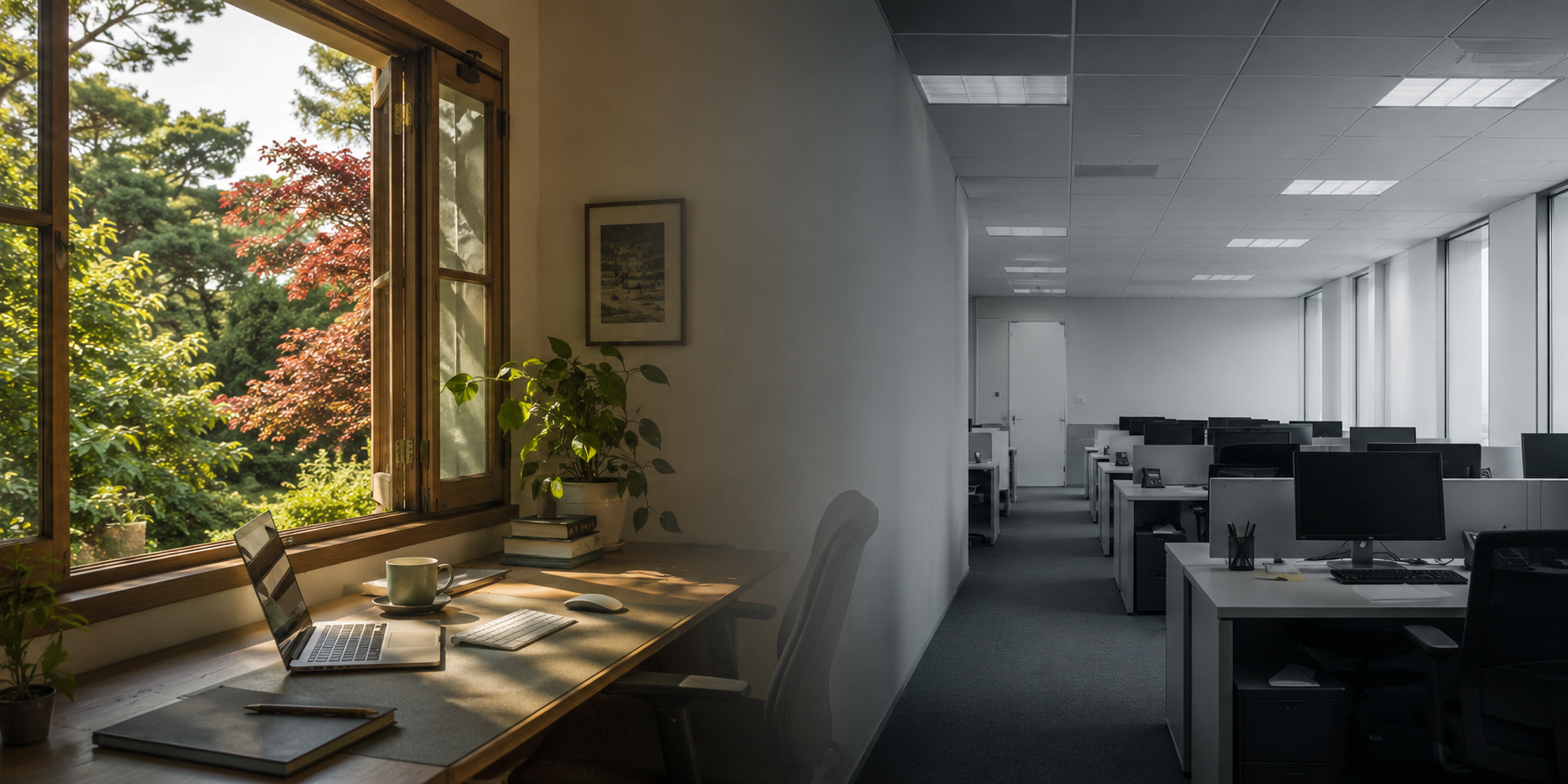
The windows are wide open. A gentle summer breeze drifts into the room, carrying the scent of warm timber, fresh grass and the garden beyond. Outside, the leaves sway quietly in the morning light. Bright greens blend with darker shades, while a few reddish leaves catch the sun. Somewhere, a blackbird begins to sing.


I take a sip of coffee.


No traffic.

No rushing.

No constant interruptions.


Just calm.


My desk is tidy. Everything is exactly where it needs to be. The screen faces a window instead of a blank wall, and beyond that window lies something no office designer can truly recreate: nature.


And then something remarkable happens.


Ideas seem to arrive more naturally.

Complex problems become easier to untangle.

Creativity does not feel forced.

It simply appears.


I am focused.

Motivated.

Completely absorbed in my work.


Not because I suddenly became more disciplined.


But because my surroundings invite me to do my best work.


Then I picture another workplace.


The alarm rings an hour earlier.


A hurried breakfast.

A crowded train.

Traffic jams.

Delays.

Commuting before the working day has even begun.


By the time the office door opens, energy has already been spent.


Grey carpet.

White walls.

Artificial lighting.

Conditioned air.

Rows of identical desks.

Phones ringing.

Someone attending yet another online meeting without headphones.

Colleagues rushing from one appointment to the next, with barely enough time for a genuine conversation.


Instead of birdsong, there is the hum of printers.

Instead of fresh air, recycled air conditioning.

Instead of trees, partition walls.


And after eight hours, the journey begins again.


Another commute.

Another hour.

Sometimes two.

Time that quietly disappears from life, day after day.


And then we wonder why so many people feel exhausted.


Beauty is not a luxury.


Somehow we have come to believe that beautiful workplaces are a pleasant extra.


Something reserved for glossy architecture magazines.

Something for impressive company headquarters.

Something nice to have.


I believe we have misunderstood something fundamental.


Beauty is not decoration.


Beauty is part of performance.


Environmental psychology has been studying this relationship for decades.


The question is surprisingly simple.


How does our environment influence the way we think, feel and work?


The answer is becoming increasingly clear.


People tend to perform better when they genuinely enjoy the place in which they work.


Our minds were never designed for sterile spaces.


For hundreds of thousands of years, humanity lived among forests, rivers, changing seasons and natural landscapes.


Only within the last tiny fraction of our history have we surrounded ourselves with concrete, glass, fluorescent lighting and endless white walls.


Our biology has not changed nearly as quickly as our architecture.


This is why nature still affects us so profoundly.


Not because it is fashionable.

Because it is deeply human.


Research in environmental psychology consistently suggests that exposure to daylight, natural materials, vegetation and views of nature can reduce stress, improve wellbeing and support sustained attention. The growing field of biophilic design is built upon precisely this understanding.


The home office can become exactly that place.


Not every home office, of course.


A laptop squeezed between yesterday’s dishes and the washing basket is hardly an inspiring workplace.


But a thoughtfully designed room with daylight, fresh air, plants and a peaceful atmosphere can become something quite different.


Not merely a place to work.

A place where good work becomes easier.


That distinction matters.


Motivation rarely grows from supervision.

It grows from trust.

From ownership.

And from environments that support rather than exhaust us.


Trust will always outperform control.


Many organisations still ask whether employees really work when they are at home.


I sometimes wonder whether that is the wrong question entirely.


Perhaps we should instead ask:


Under which conditions do people produce their very best work?


Great ideas rarely emerge because someone was required to sit at a particular desk.


They emerge through concentration.

Through autonomy.

Through deep thinking.

And through environments that allow people to flourish.


Constant interruptions rarely create innovation.

Long commutes rarely increase creativity.

Sterile workplaces rarely inspire original thinking.


Beauty quietly changes us.


Perhaps we underestimate beauty itself.


A well-kept garden calms the mind.

An old library invites reflection.

A walk beneath ancient trees often solves problems that hours at a desk could not.

A room filled with natural light changes our mood before we even notice it.


Why should our workplaces be any different?


We spend a remarkable portion of our lives working.


Surely the places in which we spend those years should nourish us rather than merely contain us.


Productivity begins long before the first task.


It begins with the first breath of fresh morning air.

With daylight falling across the desk.

With silence.

With beauty.

With a place where we genuinely want to be.


Perhaps that is the real lesson.


People seldom produce extraordinary work because they are under constant pressure.


They produce extraordinary work when they are given the opportunity to become the best version of themselves.


A beautiful workplace is therefore not an indulgence.


It is an investment.


In wellbeing.

In creativity.

In motivation.

In healthier organisations.

And ultimately, in better results.


The finest ideas rarely emerge beneath fluorescent lights.


More often, they begin beside an open window, while a gentle breeze moves through the trees and quietly reminds us that, despite all our technology, we remain creatures of nature.


Sources & Further Reading

The ideas explored in this essay are supported by decades of research in environmental psychology, architecture, neuroscience and organisational behaviour. If you would like to explore the scientific background in greater depth, the following publications provide an excellent starting point.


  • Kaplan, Rachel & Kaplan, Stephen (1989)
    The Experience of Nature – A Psychological Perspective.
    One of the foundational works introducing the concept that natural environments help restore directed attention and reduce mental fatigue (Attention Restoration Theory).
    https://archive.org/details/experienceofnatu0000kapl

  • Ulrich, Roger S. (1984)
    View Through a Window May Influence Recovery from Surgery.
    Science, Vol. 224, No. 4647.
    This landmark study demonstrated that patients with a view of trees recovered faster and required less pain medication than patients facing a brick wall.
    https://www.science.org/doi/10.1126/science.6143402

  • Boubekri, Mohamed et al. (2014)
    Impact of Office Window and Daylight Exposure on Sleep, Physical Activity and Quality of Life.
    Journal of Clinical Sleep Medicine.
    The study found that employees working in offices with windows experienced better sleep quality, greater physical activity and improved overall wellbeing compared with those working in windowless environments.
    https://jcsm.aasm.org/doi/10.5664/jcsm.3780

  • Bloom, Nicholas et al. (2015)
    Does Working from Home Work? Evidence from a Chinese Experiment.
    The Quarterly Journal of Economics.
    One of the world’s best-known studies on remote work. The experiment found higher productivity, lower employee turnover and increased job satisfaction among home-based workers under appropriate conditions.
    https://doi.org/10.1093/qje/qju032

  • Human Spaces (2015)
    The Global Impact of Biophilic Design in the Workplace.
    Based on responses from more than 7,500 office workers across sixteen countries, the report found strong associations between natural elements in the workplace and higher wellbeing, creativity and reported productivity.
    https://humanspaces.com/the-global-impact-of-biophilic-design-in-the-workplace/

  • Browning, William D., Ryan, Catherine O. & Clancy, Joseph O. (2014)
    14 Patterns of Biophilic Design.
    One of the most influential practical frameworks for integrating nature into architecture and workplace design.
    https://www.terrapinbrightgreen.com/reports/14-patterns/

  • World Green Building Council
    Health, Wellbeing & Productivity in Offices.
    A comprehensive review of international research examining how workplace design influences health, engagement and organisational performance.
    https://worldgbc.org/article/health-wellbeing-productivity-offices-the-next-chapter-for-green-building/

Author’s Note

This essay combines personal reflection with findings from environmental psychology, workplace research and architecture. While every individual experiences work differently, a growing body of scientific evidence suggests that our surroundings are far more than a backdrop. They shape how we think, how we feel and, ultimately, how well we perform.

A Guide to Clarity

Working Calmly in a Noisy World of Projects

There is a particular kind of tiredness that has nothing to do with long hours.
It is the tiredness that comes from never being fully present.

Many projects today are not failing loudly.
They do not collapse in dramatic crises or spectacular overruns.
Instead, they erode slowly.
People are busy. Calendars are full. Messages never stop.
And yet, something essential is missing: a sense of calm progress.

I have seen this across organisations, industries and project sizes.
Well-funded initiatives, staffed with competent and motivated people, still struggling to move forward.
Not because the work is too complex, but because the work environment is too noisy.

Over time, one insight has become very clear to me:

Projects rarely fail because people cannot do the work. They fail because the work is constantly interrupted.

The answer to this problem is not more pressure, more reporting or another tool.
The answer is something far more subtle, and far more powerful:
calm delivery.


What “noise” really looks like in modern projects

When people talk about noise, they often think of communication overload.
Too many emails. Too many messages. Too many meetings.

But noise is not about quantity alone.
Noise is anything that breaks continuity and makes it harder for people to think clearly about their work.

  • Constant context switching between tools, chats and tasks
  • Interruptions that break concentration and destroy flow
  • Urgency inflation, where everything is treated as critical
  • Meetings that create movement but no decisions
  • Documentation that exists, but is not trusted or used

Research from the American Psychological Association shows that switching between tasks is not free.
Every switch comes with a cognitive cost.

Additional studies by Gloria Mark at the University of California, Irvine demonstrate that frequent interruptions not only reduce productivity, but also increase stress levels
(UCI research paper).

Noise creates a dangerous illusion.
People feel active and engaged, while real progress becomes harder to see.


Why calm is not a luxury — it is a delivery strategy

In many organisations, calm is misunderstood.
It is associated with slowness, hesitation or lack of ambition.

In reality, the opposite is true.
Calm is not softness.
Calm is precision.

When people can focus, they think more clearly.
They make better decisions.
They notice risks earlier.
They produce work that does not need to be redone three times.

Scientific research supports this.
A well-known study published in Proceedings of the National Academy of Sciences shows that heavy multitaskers perform worse at filtering irrelevant information.
They are more distracted, not more capable.

Chronic noise also has long-term consequences.
The World Health Organization recognises burnout as the result of chronic workplace stress that has not been successfully managed.

Calm, therefore, is not a mood.
It is infrastructure.
It is the environment that allows good work to happen consistently.


The Calm Delivery System: six practices that restore clarity

1) Clarify outcomes before output

Many projects start with activity instead of intention.
Tasks are defined, tools are selected, timelines are discussed — but the actual outcome remains vague.

Before producing anything, it helps to slow down and ask a few simple questions:

  • What change are we actually trying to create?
  • What will be different when this work is finished?
  • How will we recognise success without lengthy explanations?

This focus on outcomes rather than outputs is increasingly reflected in modern project standards.
The PMBOK® Guide emphasises value delivery as a core principle of project management.

A calm project can usually be explained in one or two sentences — clearly and without defensiveness.


2) Decision hygiene: fewer decisions, better decisions

In noisy environments, decisions often disappear.
They are discussed repeatedly, revised informally or postponed until pressure forces action.

Calm delivery requires decision hygiene:

  • A simple, visible decision log
  • Clear ownership for each decision
  • Defined moments when decisions are made

When decisions are documented and respected, uncertainty decreases.
People stop re-litigating old questions.
Energy returns to the work itself.


3) Protect focus by designing an interruption model

If interruptions are not designed, they will design themselves.
Usually in favour of whoever is loudest or most anxious.

A calm project makes interruptions explicit:

  • Quiet hours for concentrated work
  • Office hours for questions and alignment
  • A single channel for genuine urgency
  • A rotating interruption owner

This is not about ignoring people.
It is about protecting the team’s ability to think.

Research consistently shows that task switching reduces effectiveness
(APA overview).
Focus must be treated as a shared resource.


4) Meetings as a tool — not a lifestyle

Meetings are not the problem.
Unclear meetings are.

Calm delivery treats meetings as instruments with a specific purpose:

  • Alignment meetings create shared understanding
  • Decision meetings create commitment
  • Workshops solve defined problems

Status updates are written.
Decisions are explicit.
If no decision is possible, the meeting is exploratory — and labelled as such.


5) Documentation that people actually trust

Documentation often fails because it is created as an archive.
In calm delivery, documentation is navigation.

  • One source of truth
  • A short narrative combined with a simple diagram
  • Clear ownership and versioning
  • Linked decisions and assumptions

This principle aligns closely with the Scrum Guide, which emphasises simplicity and purpose-driven elements.

Good documentation does not impress.
It reassures.


6) A small cadence that restores trust

Calm is built through rhythm.
Not control.

A very small cadence is often enough:

  • A weekly outcome review
  • A weekly risk check
  • A short written update to stakeholders

When clarity becomes predictable, interruptions decrease.
Trust grows quietly.


How calm delivery aligns with recognised frameworks

Calm delivery does not reject standards.
It uses them as reference points.

  • ISO 21502 provides high-level guidance on project management
  • PMBOK® Guide emphasises value and adaptability
  • Scrum focuses on clarity of goals
  • ITIL 4 promotes principles such as focus on value and simplicity

The aim is not methodological purity.
The aim is a working environment that supports thinking.


Calm is how senior delivery feels

In experienced teams, you can sense early whether a project will succeed.
Not by the toolset.
Not by the slide deck.

But by the atmosphere.

People know what success means.
Decisions are visible.
Focus is protected.
Documentation is trusted.
Progress is steady.

If your project feels noisy, the solution is rarely to push harder.
The solution is to design calm — deliberately.

1