
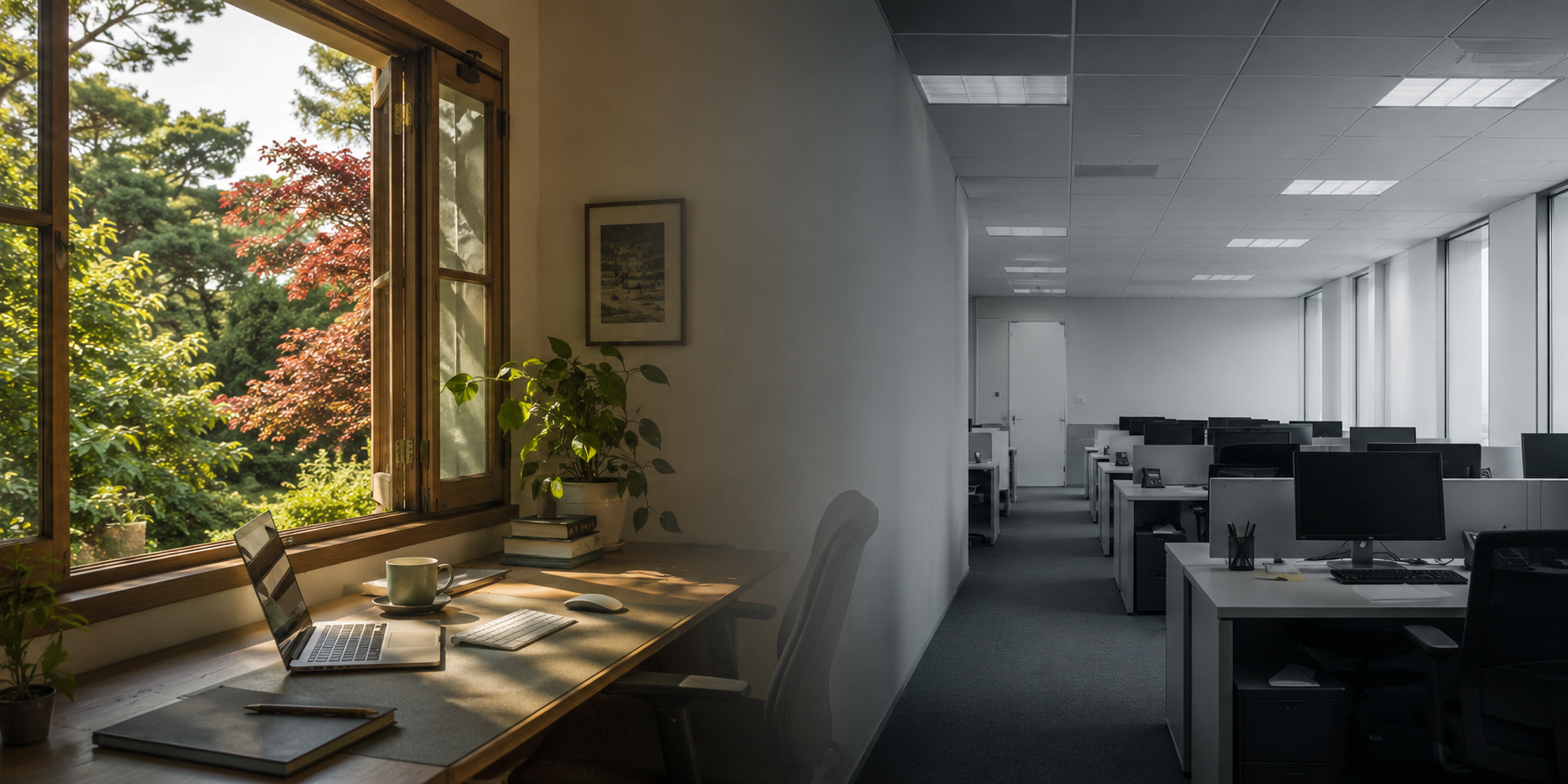
I am sitting at my desk.
The windows are wide open. A gentle summer breeze drifts into the room, carrying the scent of warm timber, fresh grass and the garden beyond. Outside, the leaves sway quietly in the morning light. Bright greens blend with darker shades, while a few reddish leaves catch the sun. Somewhere, a blackbird begins to sing.
I take a sip of coffee.
No traffic.
No rushing.
No constant interruptions.
Just calm.
My desk is tidy. Everything is exactly where it needs to be. The screen faces a window instead of a blank wall, and beyond that window lies something no office designer can truly recreate: nature.
And then something remarkable happens.
Ideas seem to arrive more naturally.
Complex problems become easier to untangle.
Creativity does not feel forced.
It simply appears.
I am focused.
Motivated.
Completely absorbed in my work.
Not because I suddenly became more disciplined.
But because my surroundings invite me to do my best work.
The alarm rings an hour earlier.
A hurried breakfast.
A crowded train.
Traffic jams.
Delays.
Commuting before the working day has even begun.
By the time the office door opens, energy has already been spent.
Grey carpet.
White walls.
Artificial lighting.
Conditioned air.
Rows of identical desks.
Phones ringing.
Someone attending yet another online meeting without headphones.
Colleagues rushing from one appointment to the next, with barely enough time for a genuine conversation.
Instead of birdsong, there is the hum of printers.
Instead of fresh air, recycled air conditioning.
Instead of trees, partition walls.
And after eight hours, the journey begins again.
Another commute.
Another hour.
Sometimes two.
Time that quietly disappears from life, day after day.
And then we wonder why so many people feel exhausted.
Somehow we have come to believe that beautiful workplaces are a pleasant extra.
Something reserved for glossy architecture magazines.
Something for impressive company headquarters.
Something nice to have.
I believe we have misunderstood something fundamental.
Beauty is not decoration.
Beauty is part of performance.
Environmental psychology has been studying this relationship for decades.
The question is surprisingly simple.
How does our environment influence the way we think, feel and work?
The answer is becoming increasingly clear.
People tend to perform better when they genuinely enjoy the place in which they work.
For hundreds of thousands of years, humanity lived among forests, rivers, changing seasons and natural landscapes.
Only within the last tiny fraction of our history have we surrounded ourselves with concrete, glass, fluorescent lighting and endless white walls.
Our biology has not changed nearly as quickly as our architecture.
This is why nature still affects us so profoundly.
Not because it is fashionable.
Because it is deeply human.
Research in environmental psychology consistently suggests that exposure to daylight, natural materials, vegetation and views of nature can reduce stress, improve wellbeing and support sustained attention. The growing field of biophilic design is built upon precisely this understanding.
Not every home office, of course.
A laptop squeezed between yesterday’s dishes and the washing basket is hardly an inspiring workplace.
But a thoughtfully designed room with daylight, fresh air, plants and a peaceful atmosphere can become something quite different.
Not merely a place to work.
A place where good work becomes easier.
That distinction matters.
Motivation rarely grows from supervision.
It grows from trust.
From ownership.
And from environments that support rather than exhaust us.
Many organisations still ask whether employees really work when they are at home.
I sometimes wonder whether that is the wrong question entirely.
Perhaps we should instead ask:
Under which conditions do people produce their very best work?
Great ideas rarely emerge because someone was required to sit at a particular desk.
They emerge through concentration.
Through autonomy.
Through deep thinking.
And through environments that allow people to flourish.
Constant interruptions rarely create innovation.
Long commutes rarely increase creativity.
Sterile workplaces rarely inspire original thinking.
Perhaps we underestimate beauty itself.
A well-kept garden calms the mind.
An old library invites reflection.
A walk beneath ancient trees often solves problems that hours at a desk could not.
A room filled with natural light changes our mood before we even notice it.
Why should our workplaces be any different?
We spend a remarkable portion of our lives working.
Surely the places in which we spend those years should nourish us rather than merely contain us.
It begins with the first breath of fresh morning air.
With daylight falling across the desk.
With silence.
With beauty.
With a place where we genuinely want to be.
Perhaps that is the real lesson.
People seldom produce extraordinary work because they are under constant pressure.
They produce extraordinary work when they are given the opportunity to become the best version of themselves.
A beautiful workplace is therefore not an indulgence.
It is an investment.
In wellbeing.
In creativity.
In motivation.
In healthier organisations.
And ultimately, in better results.
The finest ideas rarely emerge beneath fluorescent lights.
More often, they begin beside an open window, while a gentle breeze moves through the trees and quietly reminds us that, despite all our technology, we remain creatures of nature.
The ideas explored in this essay are supported by decades of research in environmental psychology, architecture, neuroscience and organisational behaviour. If you would like to explore the scientific background in greater depth, the following publications provide an excellent starting point.
Author’s Note
This essay combines personal reflection with findings from environmental psychology, workplace research and architecture. While every individual experiences work differently, a growing body of scientific evidence suggests that our surroundings are far more than a backdrop. They shape how we think, how we feel and, ultimately, how well we perform.
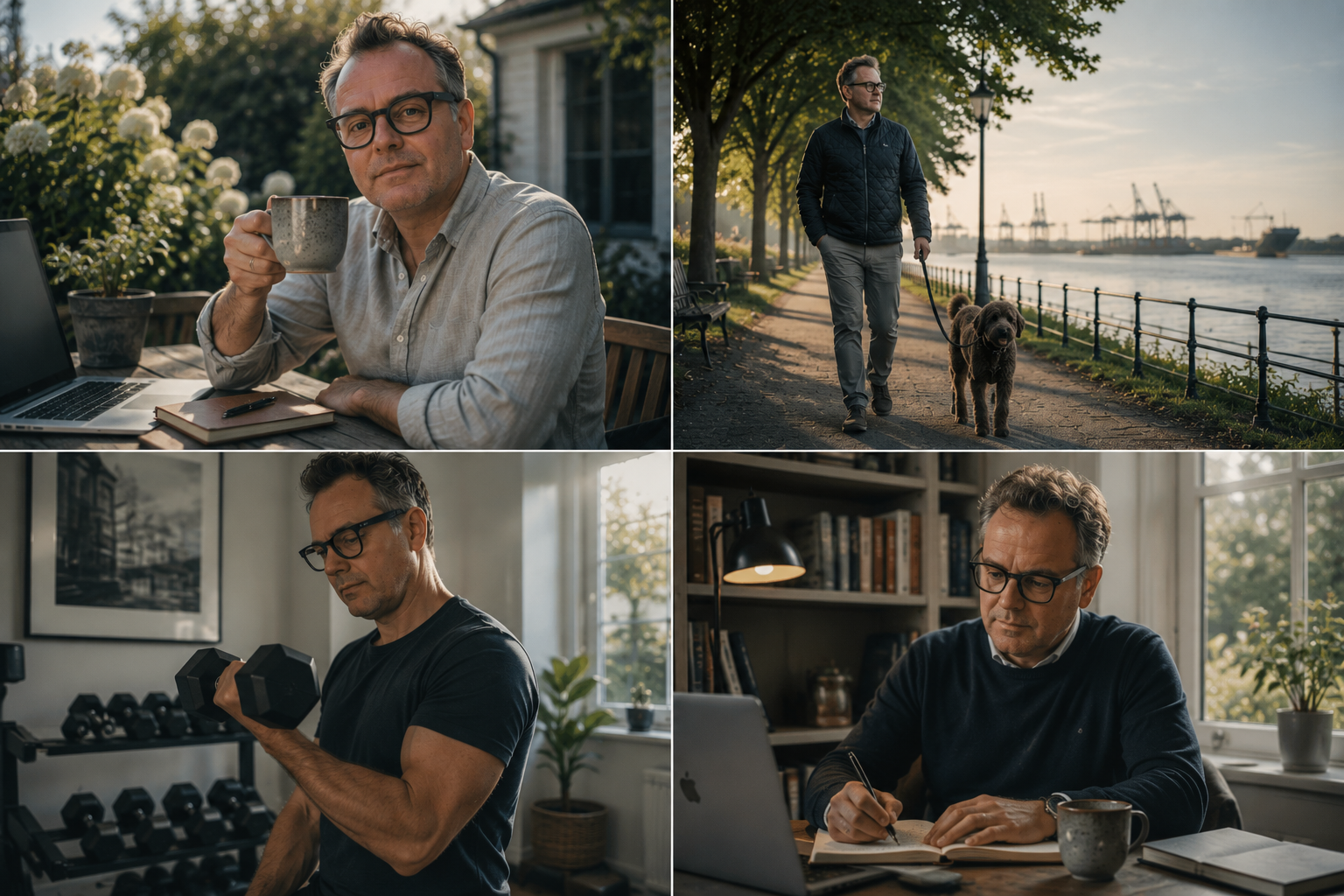
Every day begins almost the same way for me.
A good cup of coffee. A long walk with my dog. Then a workout.
Not because I jump out of bed every morning full of motivation. Quite the opposite. There are days when I would happily sleep another hour or when my mind is already occupied with projects, deadlines, or the current economic situation.
And yet, I start my day exactly like this.
Why?
Because motivation comes and goes. Consistency remains.
Many people wait for the perfect moment. The big opportunity. The one assignment that changes everything.
In my experience as a Business Analyst and Project Manager, reality works differently.
The most successful projects are not built on isolated heroic efforts. They are built because a team becomes just a little better every single day.
Individually, these tasks may seem rather ordinary. Over weeks and months, however, they create quality. And very often, that quality determines whether a project succeeds or fails.
Consistency beats perfection.
Anyone working in IT or project management today knows the feeling:
It is easy to feel as though you are constantly trying to catch up.
But nobody has to become an expert over a single weekend.
Those who invest just 20 or 30 minutes every day will learn more over the course of a year than many people who only occasionally decide that “this time I’m really going to start.”
Nothing spectacular. But incredibly effective.
The past months have shown many freelancers that the market has become more challenging.
Of course, there are days when you wonder whether submitting the next application is even worth it.
That is exactly when consistency becomes the deciding factor.
Not sending ten applications on one productive day and then doing nothing for the next week.
Instead, doing something every single day.
None of these activities may lead directly to your next project.
Together, however, they increase the likelihood every single day that the right opportunity will eventually appear.
Clients notice very quickly whether someone is reliable.
These things may seem obvious.
In practice, however, this level of reliability is one of the greatest competitive advantages you can have.
People enjoy working with professionals they know they can rely on.
We often overestimate what we can accomplish in a single day.
At the same time, we dramatically underestimate what we can achieve in a year by making small, consistent improvements every day.
That is why I continue to begin every day with a good cup of coffee, a walk with my dog, and a workout.
Not because every morning is perfect.
But because this routine reminds me that progress is rarely loud.
It is built through small decisions.
Through daily habits.
Through discipline.
And above all, through consistency.
Because in the end, careers, projects, and businesses are rarely built by giant leaps.
They are built by the small steps we are willing to take every single day.